Propeller Power

Today, we’ve figured out the dynamixal servos. The Programing team has figured out how to run the dynamixal servos in the propeller C language. The team was using an ardunio chip instead of the propeller chip. The reason the ardunio board was working and the propeller chip was not is because the circuit that “talks” to the dynamixles  is designed to run on and arduino board, which operates on five volts. The propeller board runs on 3.3 volts. The way the programming team made it work was by using a propeller c breadboard to add in some transistors to  increase the voltage output to 5 volts. With the modification the arm was able to run on the propeller chip.

img_20170304_131523670

The electronics team soldered switches with fuses together. The two switches will act as a manual overrides to completely shut down the robot if anything goes wrong. The fuse will act as a buffer between a unnaturally large electric current and the the robot’s electronics.

The black half-cylinders in the bread board are the transistors.
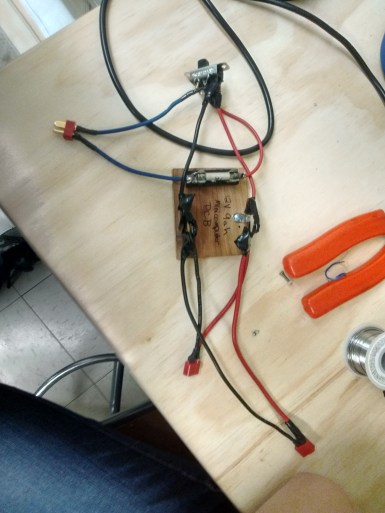
 

switch fuse.jpg

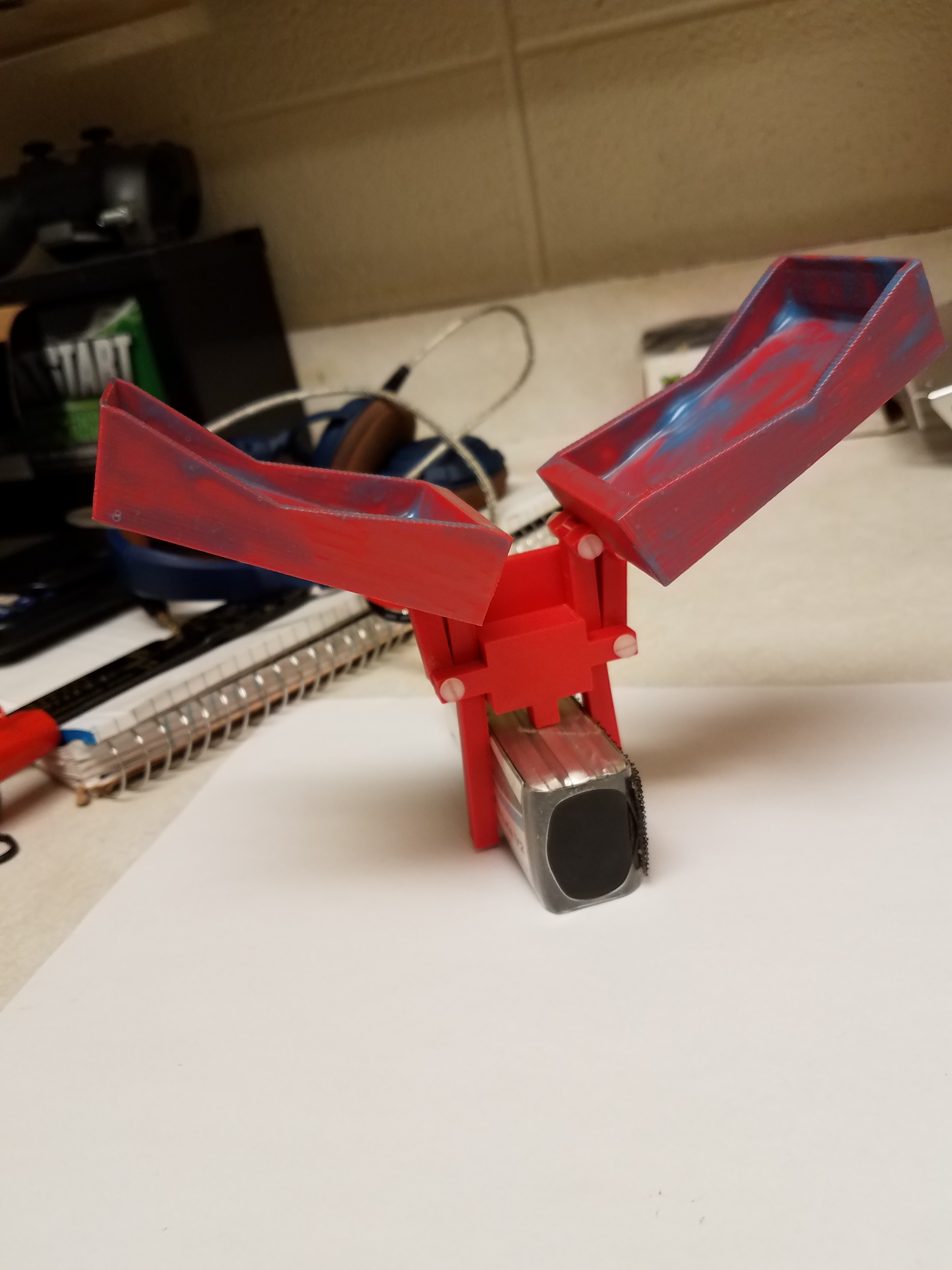
We tested Caleb’s Hand design today (Plan C) and not only is it 55 g lighter, it successfully picked up the bigger rock. The second video shows that it may need some teeth however for the smoother rocks
 

Success!

It has been a very successful day! The day started with brainstorming new ideas for the box to hold our rocks because the current one was too small. We talked about putting a slope in the center of the box or slanting the bottom of it so the rocks will slide to the lowest end. We ended up deciding on a much bigger box that is under the platform with a slippery wood for the rocks to slide around on when the robot is moving so we aren’t stuck with a pile of rocks. Mark finished building it this morning while Josh built the brackets for our batteries so they are secured to the platform.

markjosh

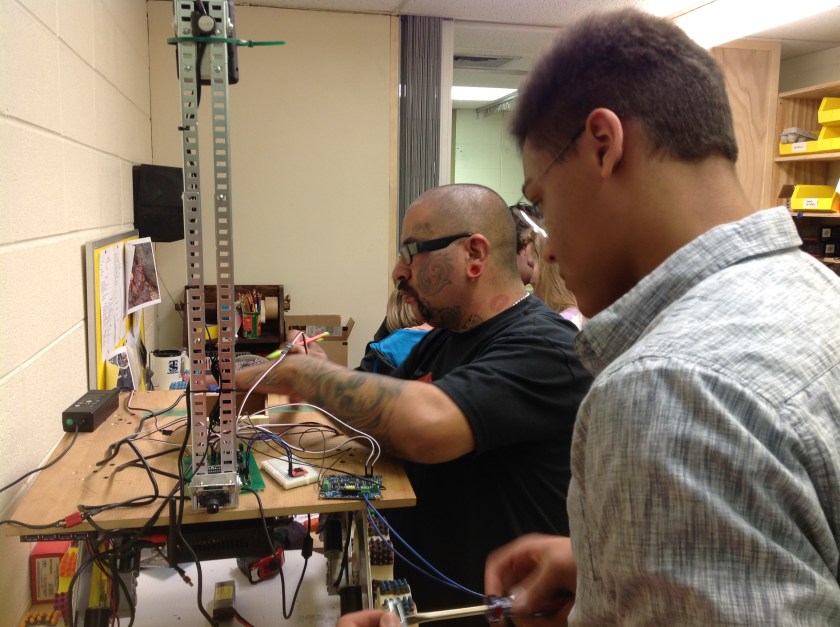
Jenny and Valon took inspiration from SABLE (our old robot) for building an on/off switch for C.L.O.E.E. They had to increase the length of some wires with wire cutting and soldering. Caleb connected the linear actuator to his hand design and 3D printed a new piece to connect it to the arm. We will be testing that shortly.

After many hours of brain wracking, Hayden figured out the problems we were having with our new servos (GO HAYDEN) and translated the code made for them to C++. Our arm is fully functional and has the power to pick up anything in its path -as long that something is less than 200g. Video below -The yellow duct tape is temporary because our hands’ servo is not connected so there wasn’t power to sold the rock in its hand.

Also, we raised $1,000 just this week! We only have $5,000 more to go, thank you to all of our contributors!


Stay Tuned Tomorrow!


The Ring-Pop Hand!

20170224_132148Another hand design has been added to our list! Our 3rd or 4th hand design (who’s counting? ) was designed by our very own Caleb Williamson. Seychelle used her resources in finding ways to dry this ring-pop colored plasi-dipped hand.
Lizzie misplaced our “perfectly” weighed  rocks, but later found them again sitting right where she left them… alone in the cold.

We also got our new Dynamixal servos and linear actuators today. Our arm is mostly assembled thanks to Alyssa and Josh. They tapped the plastic with the shorter screws that came with the servo. She used longer screws to attach the other part of the arm.

The programmers worked on the test program for the new servos, but were unable to test it today because of worries of connecting the servos to the power source. Our attempts are not aided by the fact that we went through a very traditional tech support experience.

I mean we are REALLY trying to avoid an explosion here! Hayden and Lane pondered how to reverse the polarity in our linear actuators and use them with negative voltage. Seychelle decided Google was our best option. She wasn’t fast enough however, because Hayden found the answer on the second page of the direction sheets – who reads directions these days?

Hungry Robot!

Success!! Our hand – or otherwise known as “dinosaur mouth”, is fully functional and has proven itself to be the superior hand design as of right now. We were able to program its servo to pick up rocks and drop them. Our “dino mouth” managed to engulf a golf ball, as well many other rocks that are similar to those we will encounter in the real competition. We also fed it candy, as a reward for being so cute. Now, the only thing that is left for us to do with this hand is attach it to the arm, which isn’t without its own difficulties.

Attaching the hand to the arm will be relatively easy but the main problem will be rebuilding the arm itself as the arm has provided the team with a myriad of problems, which include: the length, the weight, and the strength of all of its components. Because C.L.O.E.E.’s arm has to be long, it has consequently become too heavy. The two new servos at the base of the arm have trouble lifting the arm up. This fact has caused the team to not only shorten the arm to make it lighter, but also order new servos for the arm and redesign it as well.

Alyssa has found her “thing”, as she spent five hours straight in the physics room learning about how math can solve torque and force problems with our servos.
F = K delta X. After harassing Mr. Philbin and picking his brain, she discovered that horses have a “spring in their neck that helps the servo not have to use as much torque.” In other words, biology is a helpful resource.

We also took the rover outside and had Eric Perry from Colorado Mesa University control C.L.O.E.E remotely again. After attempting to run the rover with three of its cameras, we learned that we still have a latency issue along with the cameras fighting each other for bandwidth. We will need to compress the data stream as much as possible to avoid lag in our videos. It is very important that we have as much time as possible to react to our environment.

Hello! From Grand Junction

Today was a momentous occasion. Today we had our robot operated by an alumni student, Eric Perry, who is in Grand Junction at Colorado Mesa University! This means that we now can run our robot over large distances and we succeeded in climbing the hill that defeated the previous set of wheels.

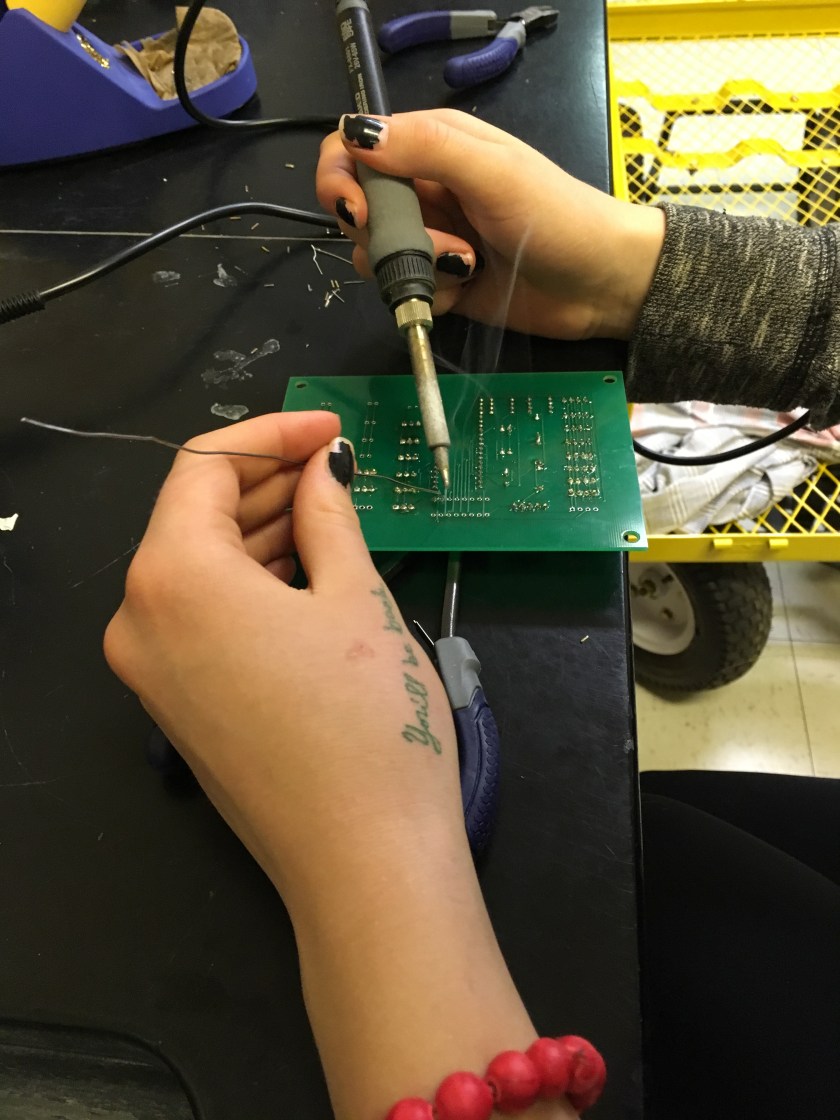
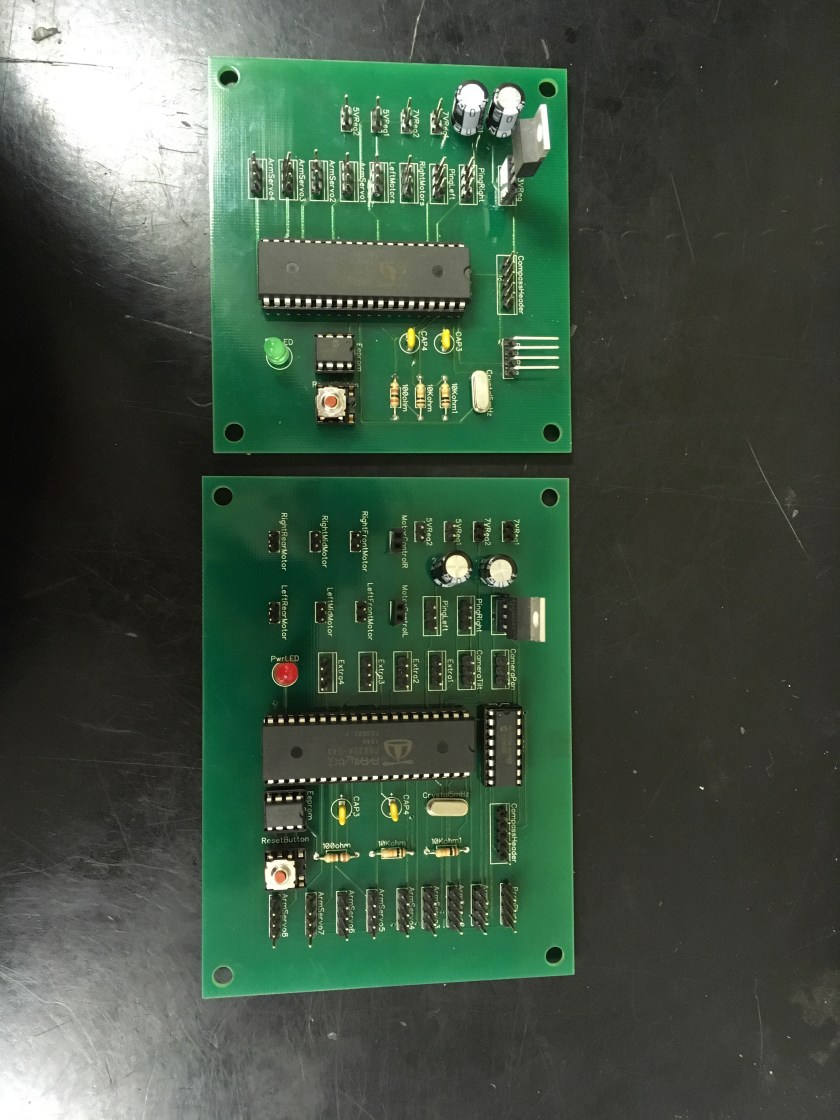
Another milestone, our updated circuit boards came in! These improved circuit boards have many more ports for connecting things like servos, motors, camera pan and tilt motion, and other empty ports for any future uses.

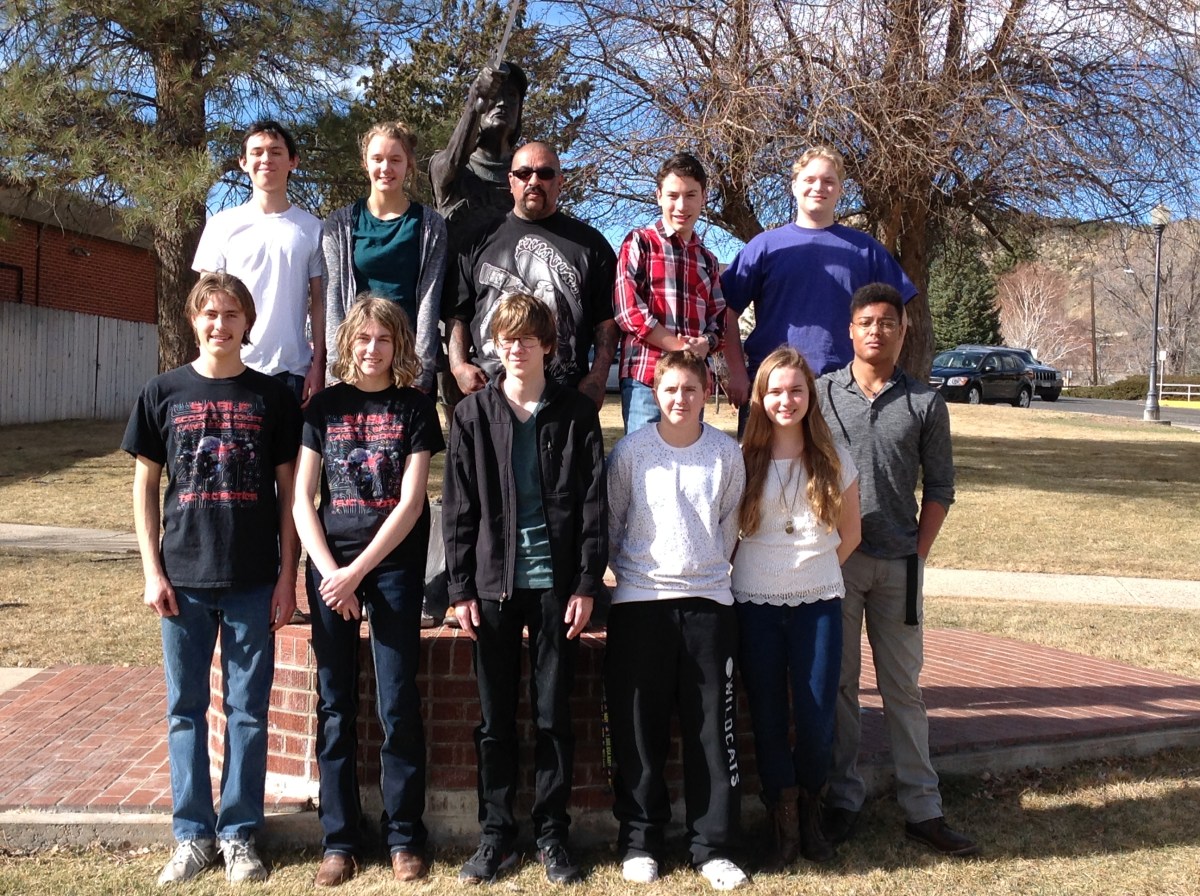
Below are pictures of the new board being soldered and a  before and after shot of the old board (on the top) and the new board (on the bottom). Also included is a picture of the robot climbing a hill, while being controlled by Eric Perry and a new team picture.

img_5831

img_5835

004


PDR meeting

pastedgraphic-2

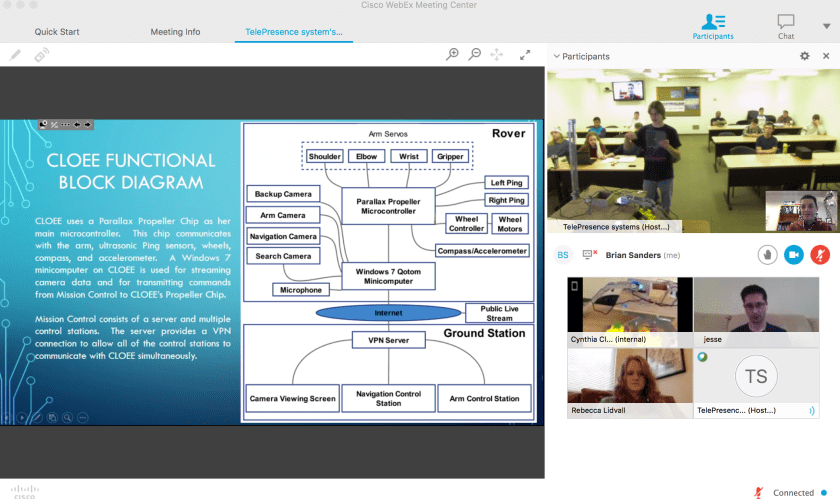
We started our day with a meeting with some engineers; Jesse Austin (from JPL), Rebecca Lidvall (ball industries), and Brian Sanders (from CU boulder), about our PDR (preliminary design review). Yesterday afternoon, we stripped the servo shaft. We started the meeting by discussing ways that we could fix it. They also talked about our contingency budget and how we should budget for fresh parts before the competition. Some other topics included; how the rocker bogie system was unbalanced, the power budget and modifying it to include time, including a battery bank instead of one large battery, the new hand design, and a bucket design to hold the rocks we collect. Most of our day has been working to fix the issues addressed in the meeting. In other news, the color of the wheels has been decided! We are going to go with black, white, and blue wheels. We tested the cameras and made sure the robot was properly synced to Mission Control (It was!). Some of our team members are working on learning the ropes of 3-D design.

Had an interesting time trying the new jetpack connection while turning.

Here we are going forward….supposed to going backward though….just a few bugs to work out.

Wheeling Around

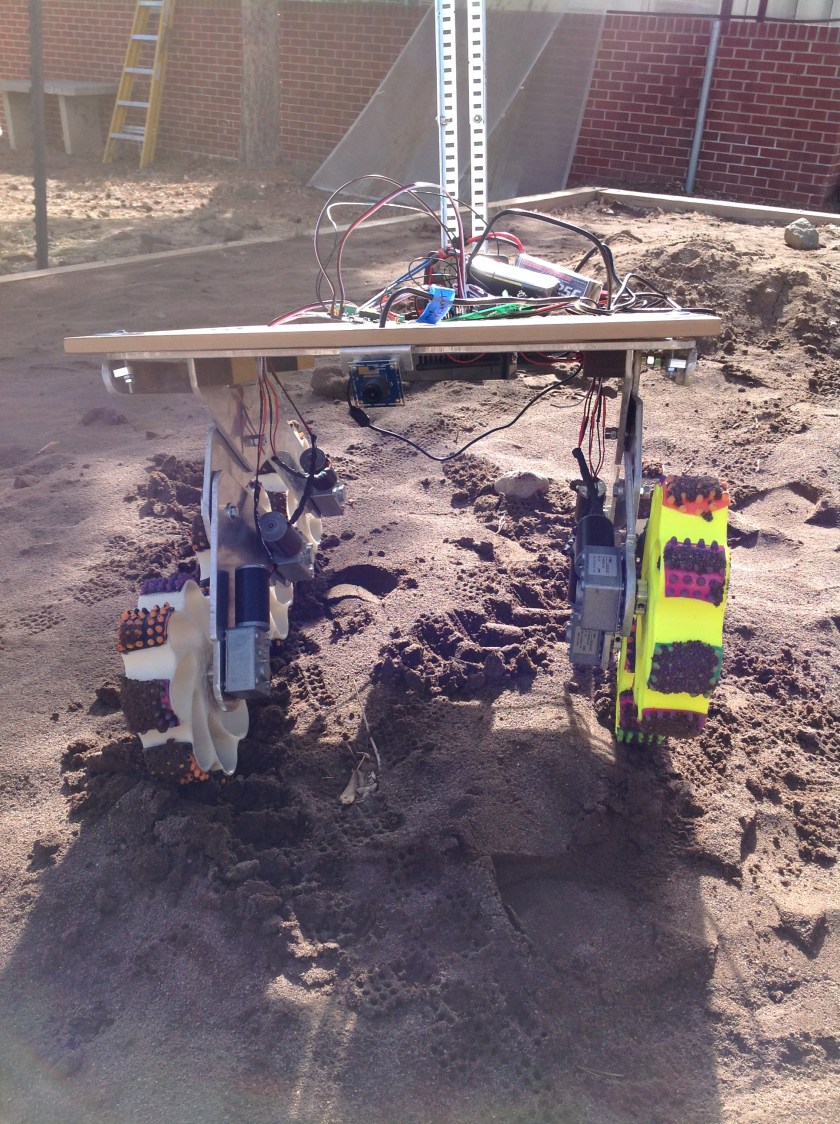
The wheels are coming, the wheels are coming! A.L.L.E.N.  may finally get his wheels back. Today, we started the production of one of the six wheels, and the electronics team redesigned the circuit board to look very, very complicated (and pink!).

In other news, we also found a battery, a 12V 40 Ah LFP battery. Caleb started working on the Plan C Hand just in case Plan B did not work.


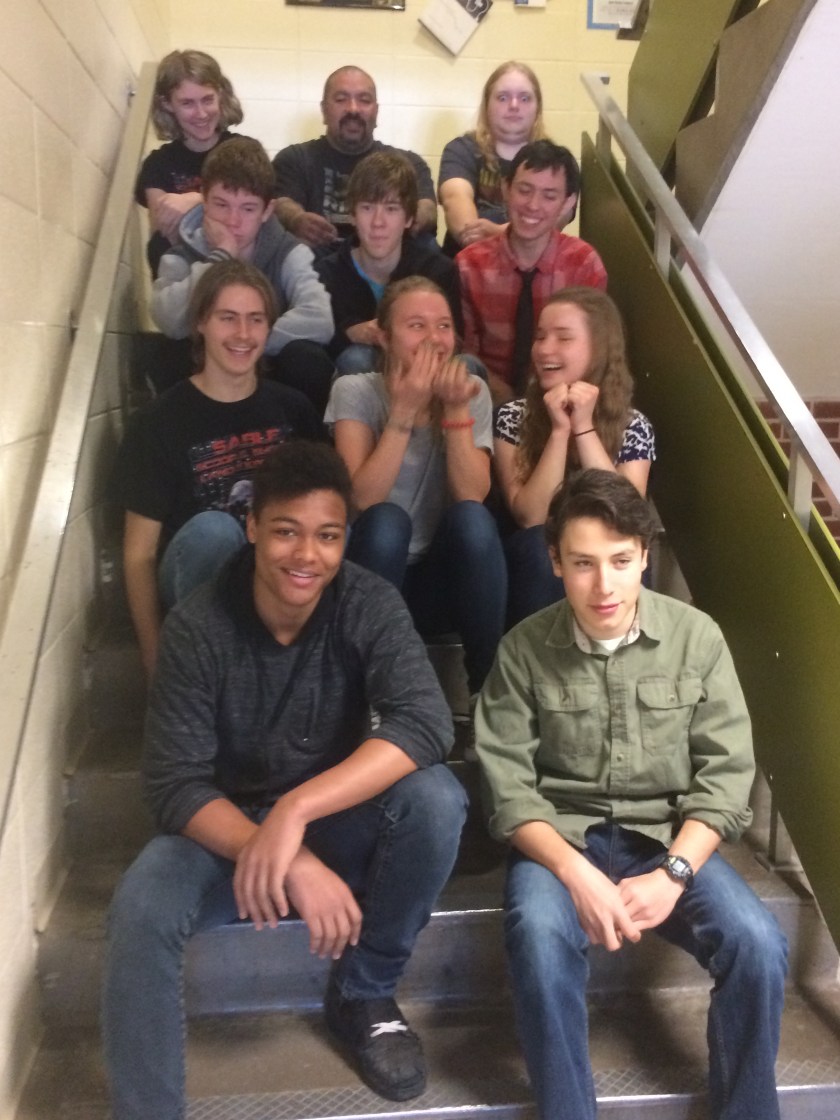
The building team also mounted the cameras so that C.L.O.E.E. can see clearly. On the topic of cameras, we got our team photo taken by the TSJC photographer; Greg Boyce. We have yet to caption this one.

teamfunny

Also finished a promotional video

Getting an Arm Up on Progress

Today, the team has been working diligently on revising and fixing the arm.  An old servo was used to test a program for the arm. Since the current servos are not able to be controlled by angle positions, the electronics and programming teams ran a series of tests. The tests were performed by cracking open a servo and attaching a fourth wire and running a program for it, multiple times. The fourth wire will be used to control the arm by angle measures of the servo.

While the electronics team worked on mastering soldering and figuring out a power budget, the programming team worked on learning how to control standard servos with the Propeller C language. The research team came to a consensus with choosing the type of a new battery. They chose a Lithium Iron Phosphate battery because it is safer than a Lithium Ion battery since it decreases the chances of an explosion that might occur with a regular Lithium ion or Lithium Polymer battery. They are still figuring out the exact amount of volts and amperes.While other teams were working, Caleb was drawing out a new schematic for the electronics circuit board.

Here are pictures Hayden is dismantling a servo for adding a new wire and Caleb working on the new schematic.

He is a She

Today, we had a revelation… CLOEE. Camera-Controlled, Land-based, Optical, Electronic, Explorer. That is her name. We made the decision to change him, into a her. She was truly meant to  be this way from the beginning, we just didn’t know it. As CLOEE was on her way to get some glamour shots, her wheels fell off as fast as we could put them on again (she wasn’t too happy). The set screws weren’t screwed far enough in the holes, but we fixed it. The team is also designing a new take on the wheels. They will be concave in on one side to save on weight, but with the same design idea as the wheels from SABLE. We have waited to 3D print the design yet for fear of another power outage, but hopefully if we plan correctly we can beat the wind – and the snow for that matter. But it’s up and running now and we are printing away. The arm is also being adjusted and changed so we can try Alfonzo’s design out.

New Years Resolution: Steal the Wheels

Leaving our wheel failure behind in 2016, we start our new year with a fairly quiet practice. A snowy night prevented some of our members from showing up to the meeting. Due to previous poor wheel performance, we are stealing the wheels from our 2013-14 robot Allen in order to attempt to fix the problem.

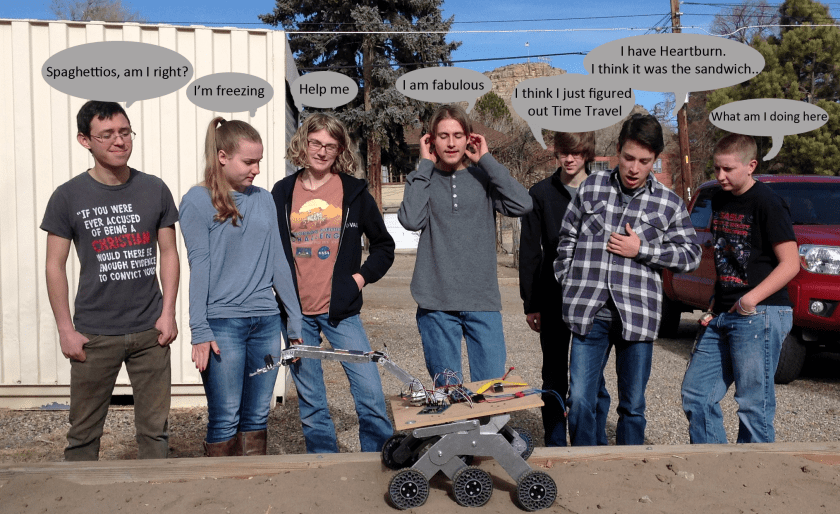
We uploaded some new videos to our YouTube channel (shameless self-promotion). Additional parts have been added to the custom printed circuit board, until the head student of the electronics department got distracted. This led to us spending some of our time editing captions onto this picture, just like every productive team should.

fabulous

We tested the servos on the arm and found the middle servo was not strong enough to lift so we are looking at new servos. Any suggestions?

Design a site like this with WordPress.com
Get started